An Offshore Wind Farm in Taiwan Strait — Subsea Cables
Named preparer on the two principal geotechnical deliverables of the submarine cable package, carried from first issue through successive client review cycles to the current revisions.
Challenge
An offshore wind farm in the Taiwan Strait, where export and inter-array cables must cross live shipping lanes over a mobile seabed. Arup is appointed to deliver the Electrical FEED Study for the submarine cable system, covering the inter-array cables (IAC), the export cable corridor (ECC) and the horizontal directional drilling (HDD) shore approach. Within the package, Bonnie is a named preparer on the two principal geotechnical deliverables — the Geotechnical Interpretation Report and the Cable Burial Risk Assessment.
Two questions drive the geotechnical scope: what the ground is like along the route — geology, strength and thermal behaviour — and how deep the cables must be buried to stay protected from fishing and shipping threats over the working life of the wind farm.
Method & Standards
🪨 Geotechnical Interpretation Report
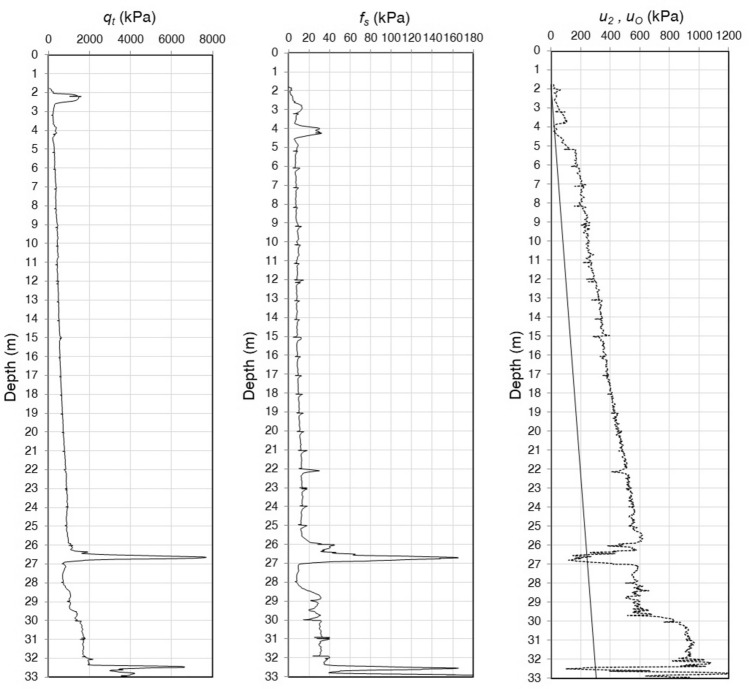
The report establishes the ground model and design geotechnical parameters along the IAC, ECC and HDD alignments. Bonnie compiled and interpreted a multi-campaign site investigation dataset acquired by PCPT profiles, borehole logs, shear wave velocity, field and onshore laboratory testing, thermal conductivity testing, and in-situ HDD testing such as mini vane and pocket penetrometer.
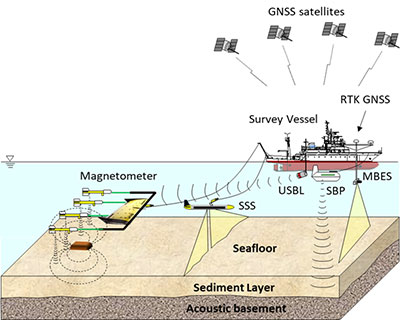
She reviewed the supporting geophysical surveys — MBES bathymetry, side scan sonar, magnetometer, sub-bottom profiler, multi-channel UHRS and UAV survey — to define seabed conditions, bedform character, buried and partially exposed pipelines, and potential underwater cultural heritage targets along the corridor. She also built and quality-assured the AGS-format geotechnical database underpinning the report, reconciling laboratory test schedules against the factual reports, verifying test counts and specification references, and resolving discrepancies between contractor submissions and the report tables.
For the issued report, she produced the graphical data summaries, geological sections and interpretation figures as controlled drawings using Python and GIS workflows for repeatable figure production. She tracked and closed client comments through the document review system, including re-issuing the report to incorporate re-run thermal test results on additional samples.
⚓ Cable Burial Risk Assessment — Carbon Trust & DNV-RP-0360
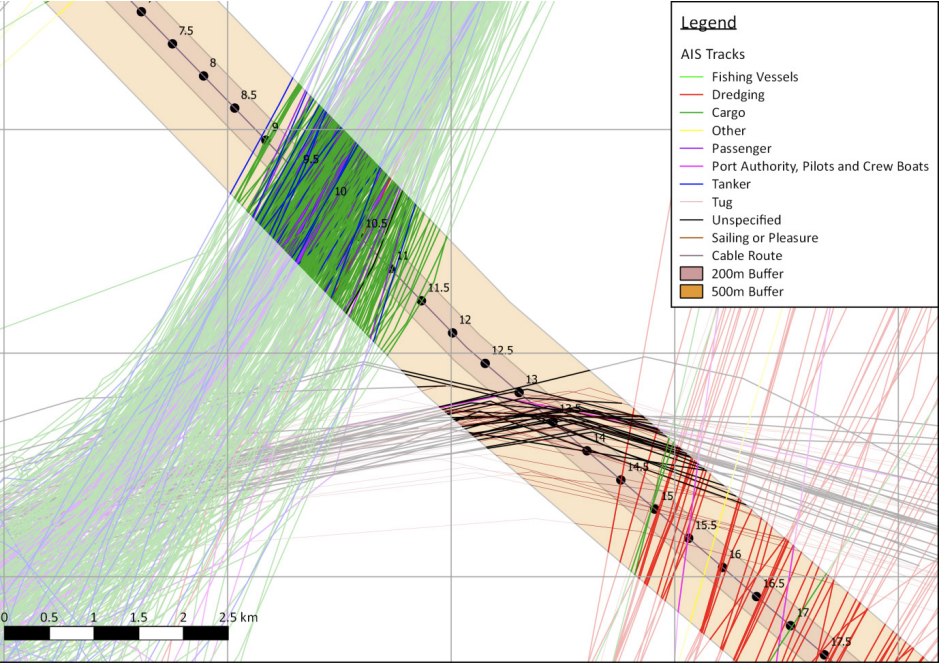
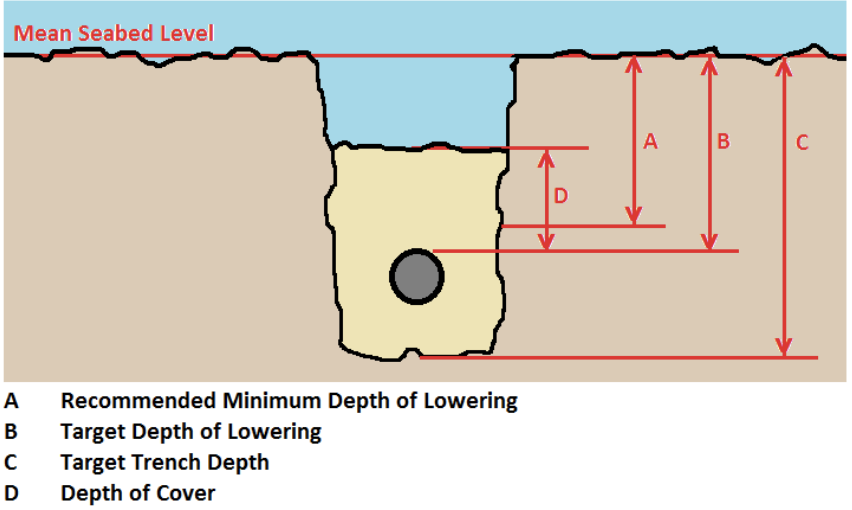
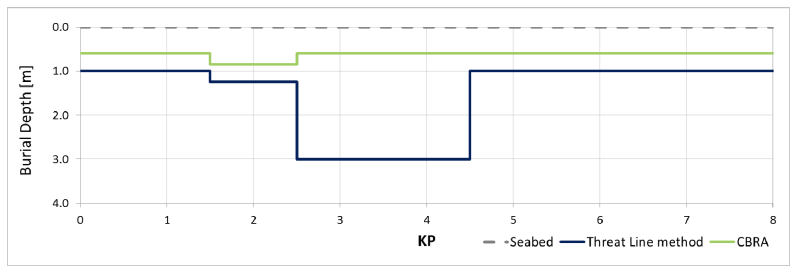
Bonnie delivered the probabilistic assessment establishing the required Depth of Lowering (DoL) for the inter-array and export cables against fishing and shipping threat lines, following the Carbon Trust Cable Burial Risk Assessment Methodology. She set up the assessment strategy for four export cables running from the landing point to the wind farm — using the outer cable of each northern and southern pair, plus each individual IAC string — to produce separate quantitative risk profiles for the two corridor positions.
The assessment covered anthropogenic and natural threats to the cables, including fishing gear interaction, vessel and anchor bands, anchor penetration into hard and soft soils, vessel movement statistics, seabed mobility, and existing or planned third-party assets and crossings. She wrote and quality-assured the Python code behind the probabilistic model, and derived the hard/soft soil classification used for the anchor penetration analysis from the interpreted PCPT and borehole data.
She contributed to the comparison of burial techniques — jetting, ploughing and mechanical cutting — against DNV-RP-0360, covering suitable soil conditions, uneven bathymetry, achievable burial depth, trench stability, advancement speed and tow force requirements. She also integrated the findings of the Technical Note for Seabed Mobility covering summer monsoon, winter monsoon and typhoon extreme events, so that burial targets account for mobile sediment levels.
Visual / Demo
Impact
As named preparer, Bonnie carried both principal deliverables through successive client review cycles, from first issue through to the current revisions. Together the Geotechnical Interpretation Report and Cable Burial Risk Assessment provide the design basis for cable burial and installation decisions — a standard-driven, defensible workflow aligned with the Carbon Trust CBRA methodology and DNV-RP-0360.